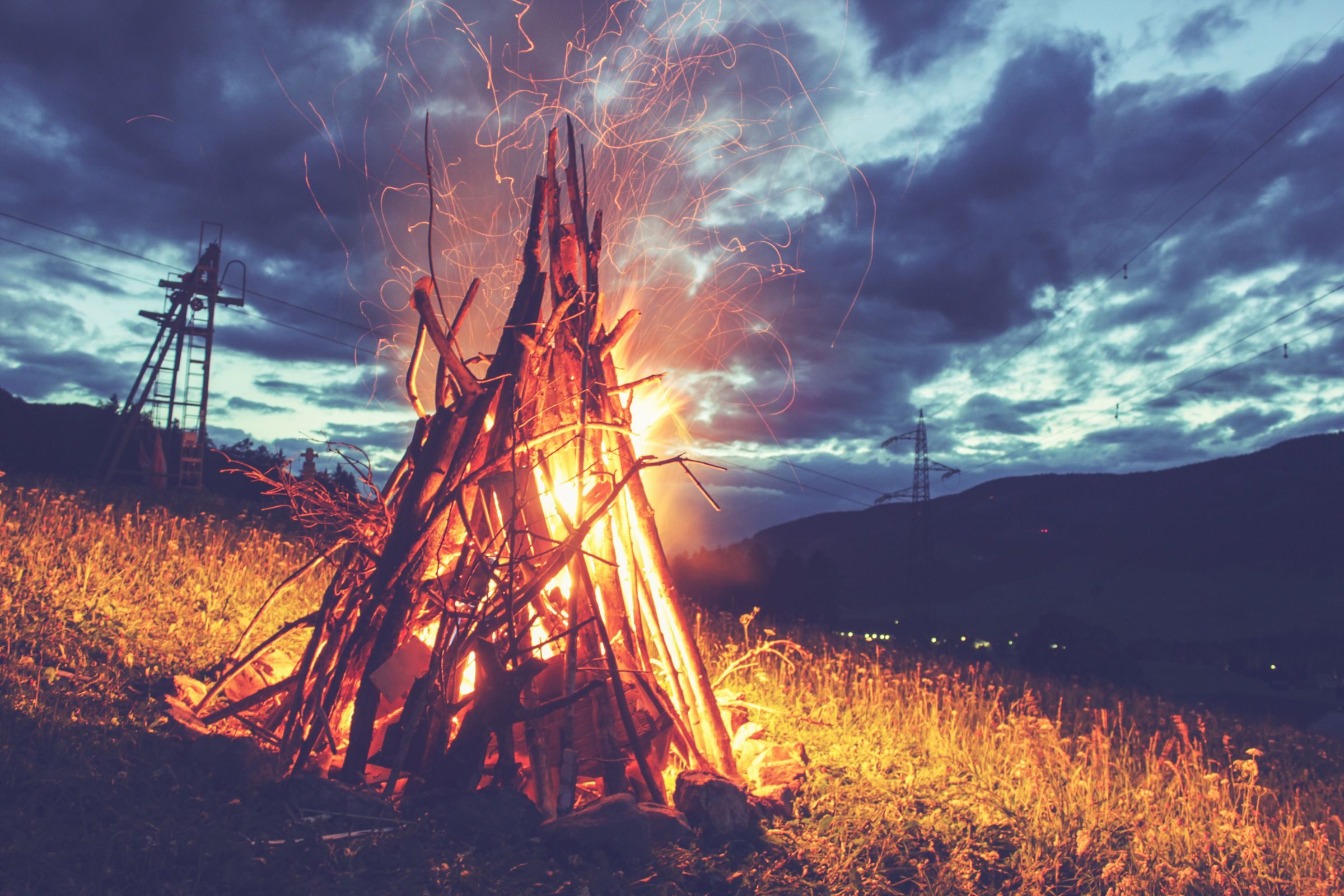
Letting go without a direction
is a slip of paper.What makes a shamanic fire ritual, and what really happens in it.
Write down what has to go, throw the slip into the fire. That's how it runs almost everywhere. Writing it down is the easy part.
Cleansing ritual. Usually part of an evening. Mind any fire bans.
In short.
A fire ritual is a letting-go or transformation ritual at an open fire. Usually you write on a slip of paper what you want to let go of, and throw it into the fire, one at a time.
What makes a fire a ritual isn't the flame. It's the intention put into it while stacking the wood. With every log.
The fire from above.
A circle around the fire, one person who keeps the fire, and one slip per person. The slip doesn't say what has to go. It says where to. That's the difference between a fire ritual and a campfire with paper.
- The circle: 5 to 30 around the fire
- Who stands at the fire: the whole time, with an intention
- The slip with a direction: written, folded, thrown
- The afterburn: nobody leaves before the fire is down
What a fire ritual is.
Fire isn't just fire. Whoever stacks it the shamanic way gives it an intention, with every log, and that decides what the fire burns for that evening. A transformation fire, a vision fire, a fire of thanks. That's craft, not magic. And it's what separates a ritual from a nice evening in the garden.
The sequence you'll find everywhere: the group stands around the fire, everyone writes on a slip what is allowed to go, and throws it in, one at a time. The decisive moment isn't the throw. It's the moment before, when you still hold the slip in your hand and ask yourself: am I really ready to let this go?
I once had an evening when a slip lay in the fire and simply wouldn't burn. All the others were gone in seconds. That one just lay there. The question that counts then is quiet and only concerns the person standing in front of it: is it okay for you to let this go now? She said yes. Then it burned.
And just as important is what comes after. Where something disappears, space opens up. If you don't know where your direction goes, the space fills by itself. Usually with what was there before.
Letting go without a direction is a slip of paper.
How it runs.
The forms differ, the sequence is almost always the same. If you know what's coming, you can take care of what matters.
Building it
The fire is stacked by hand, calmly. Whoever works the shamanic way puts the intention in while doing it. You see it if you look: whether someone is piling wood or building a fire.
The circle
The group stands around the fire. Some know each other, many don't. People talk until it gets quiet. That takes a while.
Writing it down
Everyone writes on a slip what is allowed to go. Nobody reads along. Not the leader either.
The throw
One at a time, one after another, with time. The moment before, when someone holds the slip once more, is the ritual. Not the throw.
The afterburn
The fire keeps burning, and the group stays. Usually it goes quiet without anyone asking for it.
Letting go without a direction is a slip of paper.
What you need to be clear about.
Questions before your first fire ritual.
Three for the person leading, one for you. A sentence is an answer, ten minutes aren't.
- "With what intention is the fire built?"
- "Do I have to read out what I wrote?"
- "Who stands at the fire while we throw?"
A sentence is an answer. Ten minutes aren't.
The five questions that apply to any leader have their own page: Look closely. Ask.
And afterwards?
A fire ritual works fast and then for a long time. The next morning the mood in a group often feels noticeably different, without anyone talking about it.
What you let go of is missing at first. That's allowed to feel uncomfortable. Keep the space open and point it toward what you want instead. No new ritual to confirm the old one. Let it work.
A ritual is done when it's needed.
Common questions.
Who writes this.

Around a hundred workshops with different teachers, many years as a student of two indigenous shamans in North America and Mongolia and of a teacher in the Moroccan desert. He has guided around two thousand people through rituals, safely in and safely back out.
Only what he knows from the inside himself is written here. What he hasn't done isn't here.
My intention with these pages: I share my knowledge so you can find the difference yourself. Between shamanic bullshit and something truly special.
Rituals work.The question is in which direction.
In mentoring you practise exactly that for six months: knowing where you are, seeing what is there, and holding your own direction. Even when someone else in the room has the drum.
See the mentoring